
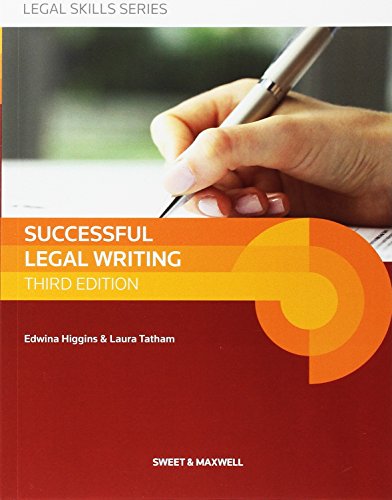
Successful legal writing Edwina Higgins; Laura Tatham
Series: Legal skillsPublication details: London : Sweet & Maxwell/Thomson Reuters, ©2015Edition: : 3rdDescription: xiv, 235 pages : illustrations ; 25 cmISBN:- 9780414037045
- 0414037049
- K94 .H53
| Cover image | Item type | Current library | Home library | Collection | Shelving location | Call number | Materials specified | Vol info | URL | Copy number | Status | Notes | Date due | Barcode | Item holds | Item hold queue priority | Course reserves | |
|---|---|---|---|---|---|---|---|---|---|---|---|---|---|---|---|---|---|---|
 Books
Books
|
Methodist University Law Library General Stacks | Reference | K94 .H53 (Browse shelf(Opens below)) | Available | 5009 |
Browsing Methodist University Law Library shelves,Shelving location: General Stacks,Collection: Reference Close shelf browser (Hides shelf browser)

|

|

|

|
No cover image available | No cover image available | No cover image available | ||
| K487.P75 F65 A psychological view of the legal system / | K884 .G75 Law for purchasing and supply. | K9 .In8 International trade & business law annual . | K94 .H53 Successful legal writing | K25 .Un4 University of Ghana Law Journal | K25 .Un4 University of Ghana Law Journal | K25 .Un4 University of Ghana Law Journal |
Previous edition: 2011.
Machine generated contents note: Writing At University --
1. Introduction --
What is the purpose of this chapter? --
What is "successful" legal writing? --
What will I be asked to write? --
How will my work be judged? --
How can I avoid common mistakes? --
How can I reflect on my own writing skills? --
Summary of chapter 1 --
2. The Process Of Writing --
What is the purpose of this chapter? --
How can I manage my time more effectively? --
How should I prioritise? --
How should I manage the writing process? --
Should I tackle problem questions in the same way? --
How will writing assignments at university be different from school or college --
I haven't written an essay for years --
how do I get back into the swing of writing? --
What help can I get with my assignments? --
Can I work with other students on assignments? --
How will the process differ from writing assignments in other disciplines? --
Summary of chapter 2 --
Preparing Your Assignment --
3. What Is The Question Asking? Note continued: What is the purpose of this chapter? --
What is diagnosis of task? --
Why is diagnosis Important? --
How do I make a diagnosis on an essay question? --
How do I make a diagnosis on a problem question? --
Summary of chapter 3 --
4. Planning And Carrying Out Your Research --
What Is the purpose of this chapter? --
How do I review my materials? --
How can I find relevant further reading? --
How do I rate what I find? --
How do I know that I'm not missing something? --
How do I record what I find? --
How can I read effectively? --
How can I improve my note-making? --
How read critically? --
Summary of chapter 4 --
5. How To Use Your Materials In The Writing Process --
What is the purpose of this chapter? --
What Is an argument? --
How do I develop effective arguments? --
What evidence do I need to use in my arguments? --
How do I integrate evidence from other sources into my own writing? --
What if I find conflicting evidence in my research? Note continued: How can I make sure my arguments progress logically? --
What Is plagiarism? --
How should my legal writing be referenced? --
Summary of chapter 5 --
Completing Your Assignment --
6. The Writing Phase --
What Is the purpose of this chapter? --
What does structure mean in academic writing? --
How do I write a successful introduction? --
How do I structure the main text of my answer? --
How do I write a successful conclusion? --
Summary of chapter 6 --
7. Writing In Good English --
What Is the purpose of this chapter? --
Isn't what I say more Important than how I say It? --
Should I make use of spelling and grammar checkers? --
I'm dyslexic --
can I overcome this? --
How can I improve my sentence construction? --
What makes up a sentence? --
What's all the fuss about apostrophes? --
When should I use an apostrophe? --
How can I Improve my spelling? --
What other matters do I need to know? --
How do I write in an academic style? --
Summary of chapter 7. Note continued: 8. Finishing Your Work And Utilising Feedback --
What is the purpose of this chapter? --
How should I review and edit my work? --
Do I need to adhere to the word limit? --
How should I present my work? --
How do I write a bibliography? --
How much of this Is relevant to exam answers? --
When is my work ready to hand in? --
What can I learn from feedback on my work? --
What does my feedback mean? --
Summary of chapter 8 --
Other Legal Writing --
9. Strategies For Other Types Of Writing --
What is the purpose of this chapter? --
How do I write a case note? --
How do I write a critical review? --
How do I write a reflective assignment? --
How do I tackle exams? --
Summary of chapter 9 --
10. Writing At The Next Level: Dissertation/Projects --
What is the purpose of this chapter? --
How do dissertations compare with other legal writing? --
Why choose a dissertation as an option? --
What is a research proposal? Note continued: Is the writing cycle different for a dissertation? --
How do I diagnose the task for a dissertation? --
How do I choose an appropriate dissertation topic? --
How do I choose a critical perspective for my dissertation? --
What is meant by "hypothesis" and "research questions"? --
How do I choose an appropriate title? --
How do I plan and structure my dissertation? --
How do I research and write up my dissertation? --
What particular requirements are there for the finishing stage? --
Summary of chapter 10 --
There are no comments on this title.