
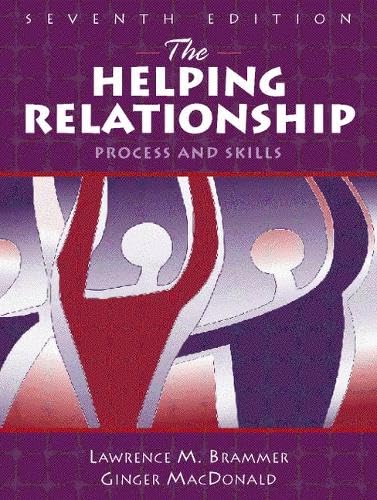
The helping relationship : process and skills / Lawrence M. Brammer, Ginger MacDonald.
Material type: TextPublication details: Boston : Allyn and Bacon, c1999.Edition: 7th edDescription: ix, 198 p. : ill. ; 24 cmISBN:
 - 0205290426
- 9780205290420
- BF637.H4 B7
| Cover image | Item type | Current library | Home library | Collection | Shelving location | Call number | Materials specified | Vol info | URL | Copy number | Status | Notes | Date due | Barcode | Item holds | Item hold queue priority | Course reserves | |
|---|---|---|---|---|---|---|---|---|---|---|---|---|---|---|---|---|---|---|
 Books
Books
|
Methodist University Library Main General Stacks | Reference | BF637.H4 B7 (Browse shelf(Opens below)) | Available | 16490 |
Browsing Methodist University Library Main shelves,Shelving location: General Stacks,Collection: Reference Close shelf browser (Hides shelf browser)

|

|
|

|

|
|

|
||
| BF637.C6 W42 Ethics in counseling and psychotherapy : | BF637.C6.W44 The counseling process : | BF637.C6.W44 The counseling process : | BF637.H4 B7 The helping relationship : | BF637.I5 .I93 Intentional interviewing and counseling : | BF637.I5 .I93 Intentional interviewing and counseling : | BF637.I5 B37 The helping interview / |
Includes bibliographical references and index
Each chapter concludes with "Suggestions for Further Study." Preface.
1.Helping: What Does It Mean? What Is Your View of Helping?The Helping Process.Facilitating Helpee Growth.Responsibility.Helping by Agreement.Meeting Helpee Needs.Seeking Wellness.Motives: To Be or Not to Be a Helper.Science and Art of Helping.Effectiveness of Helping.Professionals and Paraprofessionals.Community Helping.Peer and Cross-Age Helping.Self-Help Groups.Helping Is Learning Self-Help Coping Skills.Helping Skills Model for Understanding, Support, and Action.
2.Characteristics of Helpers. Why Is Helping Effective in Assisting People to Grow?Levels and Styles of Functioning.The Helper Personality.A Concluding Statement.
3.The Helping Process. Relationship.The Helping Process as Experienced.Stages in the Helping Process.A Process Dilemma.
4.Helping Skills for Understanding. Rationale for Skills Training.Skill Cluster 1: Listening.Skill Cluster 2: Leading.Skill Cluster 3: Reflecting.Skill Cluster 4: Challenging.Skill Cluster 5: Interpreting.Skill Cluster 6: Informing.Skill Cluster 7: Summarizing.
5.Helping Skills for Loss and Crisis. Human Conditions of Concern.Definitions of Terms.Strategies for Helping in Crises.Skills for Support and Crisis Management.
6.Helping Skills for Positive Action and Behavior Change. The Action Approach to Helping.Problems and Goals.Problem Solving, Decision Making, and Planning.Behavior Changing.
7.Ethical Issues in Helping Relationships. What Are Ethics?Helper Self-Care.Ethics and Interpersonal Relationships.Helper Competence and Limitations.Emergency/Crisis Response.Websites.
8.Thinking about the Helping Process. Theory as a Guide.A Personal Theory of Helpfulness.General Theories of the Helping Process.Social Issues.Tying Theory to the Practice of Helping Skills.When Helpees Do Not Change.Helping through Groups.Personal Epilogue.
Bibliography.
Index.
There are no comments on this title.