
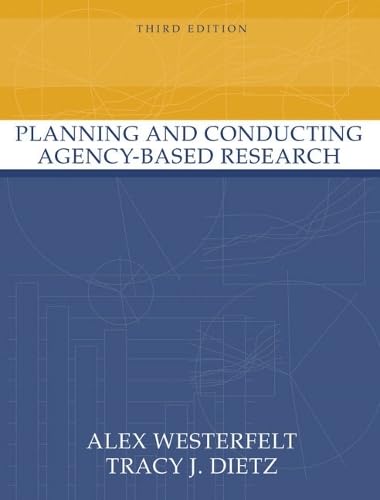
Planning and conducting agency-based research/ Alex Westerfelt; Tracy J Dietz
Material type: TextPublication details: Boston : Pearson, ©2005.Edition: 3rd edDescription: xi, 203 pages ; 28 cmISBN:
 - 0205386873
- 9780205386871
- HV11 .W51
| Cover image | Item type | Current library | Home library | Collection | Shelving location | Call number | Materials specified | Vol info | URL | Copy number | Status | Notes | Date due | Barcode | Item holds | Item hold queue priority | Course reserves | |
|---|---|---|---|---|---|---|---|---|---|---|---|---|---|---|---|---|---|---|
 Books
Books
|
Methodist University Library Main General Stacks | Reference | HV11 .W51 (Browse shelf(Opens below)) | 1 | Available | 4040 | ||||||||||||
|
Books
|
Methodist University Library Main General Stacks | HV11 .W51 (Browse shelf(Opens below)) | 2 | Available | 36525 |
Browsing Methodist University Library Main shelves,Shelving location: General Stacks,Collection: Reference Close shelf browser (Hides shelf browser)

|

|

|

|

|

|

|
||
| HV11 .So1 Social work research and evaluation : | HV11 .St8 Social work practice : | HV11 .T56 Generalist social work practice : | HV11 .W51 Planning and conducting agency-based research/ | HV11 .W55 Introduction to social work research / | HV11 .W67 Research in social work : | HV11 .Ye2 Research methods for social workers / |
Includes Bibliography
Introduction. Agency-Based Research.New in this Edition.Acknowledgments.Layout of the Workbook.How to Use This Workbook. Special Note to Students.Special Note to Course Instructors.Special Note to Field Instructors.Special Note to Agency Staff.A Final Note.1. Orientation to Agency Research. If the Agency Has a Research Program.If the Agency Does Not Have a Research Program.Staff Views and Usage of Research.Agency Resources for Your Research.Timeframe for Your Research Project.2. Protection of Research Participants (Preliminary). The University IRB.The Agency IRB.Prepare a Time Line for Your Human Subjects' Review Application.3. The Research Question. What Would You Like to Know?What Would the Agency Like to Know?What Would the Clients Like to Know?What Is Your Research Question?List of Student Research Questions and Design Type.Browse the Literature.Related to Your Topic.Refine Your Research Question.Finalize Your Research Question.4. The Literature Review. Conduct a Literature Search.Evaluate and Critique the Literature.Write the INTRODUCTION Section.Write the LITERATURE REVIEW Section.Annotated Example of a Literature Review.5. Choosing Your Methodology and Developing a Time Line. Determine the Purpose of Your Study.Develop Your Proposed Time Line.Submit Proposed Study to Your Course Instructor.Study Timeline Template.6. Survey Research. Translate Concepts and Variables into Measures.Construct Your Research Questionnaire.Plan How to Administer Your Questionnaire.Pilot Your Research Instrument and Plan for Data Collection.Write the METHODS Section.Data Collection.7. Qualitative Research. Develop the Interview Agenda (Your Research Instrument).Plan How to Conduct Interviews.Pilot Your Interview Agenda and Plan for Data Collection.Write the METHODS Section.Data Collection.8. Single-Subject Design Research. Translate Concepts into Variables.Translate Variables into Measures.Identify the Specific Single-Subject Design.Write the METHODS Section.Data Collection.9. Outcomes Evaluation. Developing the Rationale for the Intervention: A Logic Model.Developing Program Outcomes and their Measures.Choosing a Design.Threats to Internal Validity.Selecting a Sample and Assigning Groups.Writing the Methods Section.Data Collection.Example of a Logic Model.10. Sample Design. For Probability Samples.For Nonprobability Samples.Write the SAMPLE Section.11. Protection of Research Participants. Construct a Consent Form.Outline Procedures for Obtaining Informed Consent.Confidentiality Safeguards.Request Agency Approval.Request IRB Approval.Sample Consent Forms.12. Data Analysis for Surveys and Outcomes Evaluation. Presentation of Descriptive Information.Statistical Tests for Descriptive Data.Presentation of Group Comparisons.Statistical Tests for Group Comparisons.Testing the Relationship Between Continuous Variables.13. Data Analysis for Qualitative Research. First Level Coding.Second Level Coding.Select Excerpts to Represent Each Theme.Obtain Feedback from Research Participants.Relate your Findings to the Literature.14. Data Analysis for Single-Subject Design Research. Visual Significance.Statistical Significance.Substantive or Clinical Significance.15. Writing the Final Report. Rewrite Earlier Sections of Your Paper.For the SAMPLE Section.Write the FINDINGS Section.Write the DISCUSSION Section.Compile the REFERENCES.Compile the APPENDIXES.Write the ABSTRACT.Final Checklist.Research Paper Outline.Workbook Bibliography. Appendix.
There are no comments on this title.