
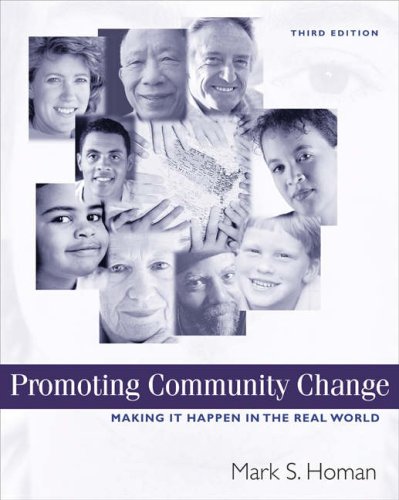
Promoting community change : making it happen in the real world / Mark S. Homan.
Material type: TextPublication details: Belmont, CA : Brooks/Cole--Thomson Learning, c2004.Edition: 3rd edDescription: xviii, 532 p. : ill. ; 24 cmISBN:
 - 0534606334
- 9780534606336
- HN90.C6 .H75
| Cover image | Item type | Current library | Home library | Collection | Shelving location | Call number | Materials specified | Vol info | URL | Copy number | Status | Notes | Date due | Barcode | Item holds | Item hold queue priority | Course reserves | |
|---|---|---|---|---|---|---|---|---|---|---|---|---|---|---|---|---|---|---|
 Books
Books
|
Methodist University Library Main General Stacks | Reference | HN90.C6 .H75 (Browse shelf(Opens below)) | 1 | Available | 4718 |
Includes Index.
Part I. Responding to the Need for Community Change --
Chapter 1. Understanding the Challenge to Change --
What's Going On Out There? --
Can You Really Do Anything About All Those Problems? --
Some Basic Issues That Deserve Your Attention --
Need for Cultural Awareness, Respect, and Competency --
Community as Client --
Targets for Community Change --
Modest Recognition of Idealism --
Chapter 2. Theoretical Frameworks for Community Change --
Systems Theory and Communities --
Healthy Communities Produce Healthy People --
Theoretical Perspectives on Community Change --
Close Communities Provide a Context for Action --
Theory and Philosophy of Praxiology --
Supporting Theoretical Propositions --
Organizing Models for Community Change --
Community Development Model --
Chapter 3. Relating Community Change to Professional Practice --
Basic Purposes of Social Welfare --
Traditional Approaches to Professional Practice --
Implications of Professional Values --
Under the Guise of Caring --
You Have the Theoretical Base --
You Have the Skills You Need --
Chapter 4. Putting Yourself in the Picture --
Taking Action --
Recognize Your Ability to Promote Change --
Developing Sanction --
Keeping Your Personal Life Happy and Healthy --
Ten Pondering Questions --
Avoid Burnout --
Some Keys to Personal Effectiveness --
Final Five --
Part II. Putting the Pieces Together --
Chapter 5. Taming the Green Eyed Monster: Using Information and Communication Technology --
Digital Divide --
Introducing the Internet --
Searching the Web --
Learning About Your Community --
Learning About Your Issue --
Record Keeping --
Making Provocative Presentations --
Putting Yourself Out There --
Working Together --
Communicating with Members of Your Organization --
Training and Support --
Chapter 6. Knowing Your Community --
Perspectives on Community --
What to Look for in Your Community --
How to Find Out What You Need to Know --
Chapter 7. Power --
Do You Need Power? --
Fear of Power --
Who Has Power? --
Assessing and Building Your Own Bases of Power --
Developing Personal Power in the Broad Community --
Using Your Power --
Empowering Others --
Chapter 8. Powerful Planning --
Some Basic Reasons for Planning --
How Much Planning Is Needed? --
Levels of Planning --
Obstacles --
Chapter 9. People --
The Most Valuable Resource --
Getting People Involved --
Working with Volunteers --
Cultural Competency --
Some Reflections on People --
Chapter 10. Raising Other Resources --
Building Your Budget --
Hustling for the Things You Need --
Getting and Spending Money --
Filling the Coffers --
Contributions from Individuals --
Using the Internet as a Fund-Raising Tool --
Securing Funds from Public and Private Organizations --
Grant Writing --
Verbal Presentations --
Collaboration --
Strings Attached --
Chapter 11. Getting the Word Out --
Importance of Making Your Efforts Known --
Identifying the People You Need to Reach --
Three Holy M's --
Techniques for Sending the Message That You Control --
Review of Methods Other People Control --
Chapter 12. Building the Organized Effort --
Organizations Are Built Around Issues --
Bringing the Organization Along --
Developing Your Organization --
Theory of Structural Limitations --
General Stages of Organizational Development --
Small Group Process --
Types of Organizations --
Incorporating --
Chapter 13. Taking Action --
Strategies and Tactics --
Major Action Strategies and Tactics --
Other Strategic and Tactical Considerations --
Tricks for Special Occasions --
Strategies and Tactics the Target May Use on You --
Commandments of Change --
Do You Have What It Takes? --
Part III. Closer Look at Typical Change Contexts --
Chapter 14. Enhancing the Quality of Neighborhoods --
Quality Neighborhoods --
Natural Processes of Neighborhood Change --
Understanding Neighborhood Organization --
Comprehensive Neighborhood Revitalization Program --
Additional Factors Related to Successful Neighborhood Change --
Enhancing the Prospects for Success --
Something for the Children --
Chapter 15. Increasing the Effectiveness of Established, Formal Organizations --
Types of Changes --
Elements Affecting the Behavior of Organizations --
Additional Processes Influencing Change --
Principles for Increasing Your Effectiveness --
Breakfast at Tommie's --
Chapter 16. Lobbying for Change --
Basic Components of an Organized Lobbying Effort --
Skeletal Outline of the Legislative Process --
Basic Lobbying Activities --
Other Things You Should Know or Do to Increase Your Effectiveness --
Hearing.
There are no comments on this title.