
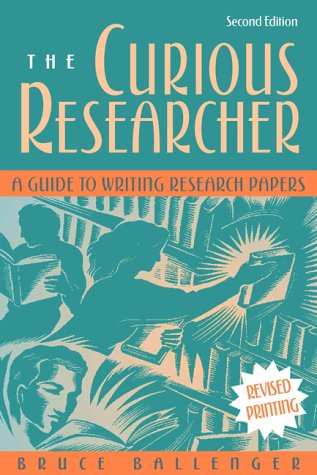
The curious researcher : a guide to writing research papers / Bruce Ballenger.
Material type: TextPublication details: Boston : Allyn and Bacon, c1999.Edition: 2nd rev. edDescription: xxvii, 340 p. : ill. ; 23 cmISBN:
 - 0205297021 (alk. paper)
- LB2369 .B246 1999
| Cover image | Item type | Current library | Home library | Collection | Shelving location | Call number | Materials specified | Vol info | URL | Copy number | Status | Notes | Date due | Barcode | Item holds | Item hold queue priority | Course reserves | |
|---|---|---|---|---|---|---|---|---|---|---|---|---|---|---|---|---|---|---|
 Books
Books
|
Methodist University Library Main | LB2369 .B246 1999 (Browse shelf(Opens below)) | Available | |||||||||||||||
|
Books
|
Methodist University Library Main General Stacks | Reference | LB2369 .B246 1999 (Browse shelf(Opens below)) | Available | 29243 |
ntroduction: Rethinking the research paper Exericse 1 This I believe Unlearning 101 Using this book The exercises The five-week plan Alternatives to the five-week planThe research paper versus the research report Discovering your purposeHow formal should it be?The question is you Thinking like an academic writerA method of discoveryFiring on four cylinders of informationFacts don't kill Exercise 2 Reflecting on Theories of Intelligence by Bruce BallengerCreative research papers? Chapter 1: The First WeekThe importance of getting curious Seeing the world with wonder Getting the pot boliing Exercise 1.1 Builing an interest inventory Other ways to find a topic What is a good topic? Where's Waldo and the organizing power of questions Exericse 1.2 The myth of the boring Making the most of an assigned topicDeveloping a working knowledge Case study on developing working knowledge: Theories of dog training Research strategies for developing working knowledge Software to manage your researchThe reference librarian: A living sourceNarrowing the subject Exercise 1.3 finding the question Crafting your opening inquiry questionPossible purposes for a research assignment Exercise 1.4 Research proposalReading for research Reading rhetorically Strategies for reading rhetorically Chapter 2: The Second WeekWhat are your research routines? Google vs. the library Planning the dive Find enough information by using the best search termsIndex searches using the Library of Congress subject headings Keyword searching in library databasesKeyword searches on the world wide web Find varied sources Primary vs. secondary sources Objective vs. subjective Stable or unstable? Find quality sources When was it published? Why journal articles are better than magazine articles Look for often-cited authors Not all books are alike Evaluating online sources A key to evaluating Internet sources Developing focused knowledge What about a thesis? Suspending judgment? Testing assumptions? What are you arguing? Keeping track of what you find: Building a bibliography Searching library databases for books and articles Finding Books Understanding call numbers* Coming up empty-handed? Checking bibliographies Interlibrary loan Article databases Saving search resultsAdvanced Internet research techniques Types of search engines Exercise 2.2 Academic research on the InternetLiving sources: Interviews and surveys Arranging interviews Finding experts Finding nonexperts affected by your topic Making contact Conducting interviews The e-mail interview Planning informal surveys Avoid loaded questionsAvoid vague questionsDrawbacks of open-ended questionsDesigning your multiple choice questionsUsing scaled responses Conducting surveys Fieldwork: Research on what you see and hear Preparing for fieldwork Notetaking strategies Using what you see and hear Exercise 2.4 DataViz: Tell a story with facts Chapter 3: The Third WeekWriting in the middle Conversing Exercise 3.1 Getting into a conversation with a fact Plagiarism: What it is, why it matters, and how to avoid it Plagiarism Q & A Exercise 3.2 Saying it back to a source Why plagiarism matters A taxonomy of copying, quotation, paraphrase, and summary Paraphrasing Summarizing Quoting Notetaking Exercise 3.3 Dialogic notetaking: Listing in, speaking up "What? I Failed" by Thomas Lord Notetaking techniques The double-entry journal The research log Narrative notetaking Online research notebooks When you're coming up short: More advanced searching techniques Advanced library searching techniques Advanced Internet search techniques Thinking outside the box: Alternative sources Exercise 3.4 Building an annotated bibliography Chapter 4: The Fourth Week Getting to the draft Exploration or argument? Exercise 4.1 Dialogue with Dave S.O.F.T. Organizing the draft Delayed thesis structure Question-claim structure Exploring or arguing: An example Preparing to write the draft Refining the question Refining the thesis Exercise 4.2 Sharpening your pointDeciding whether to say I Getting personal without being personal Starting to write the draft: Beginning at the beginning Flashlights or floodlights? Writing multiple leads Exercise 4.3 Three ways in Writing for reader interest Whose steering and where to? Working the common ground Putting people on the page Writing a strong ending Using surprise Writing with sources The weave of research writing Handling quotes Other quick tips for controlling quotations Citing sources Driving through the first draft Chapter 5: The Fifth WeekRevising is re-seeing (or breaking up is hard to do) Global revision: Revising for purpose, thesis, and structure Writer- to reader-based prose Exercise 5.1 Wrestling with the draft Reviewing the structure Exercise 5.2 Directing the reader's respose Using your thesis to revise Exercise 5.3 Cut and paste revisionExamining the wreckage Other ways of reviewing the structure Re-researching Finding quick facts Local revision: Revising for language Who are you in the draft Tightening seams between what you say and what they say Scrutinizing paragraphs Scrutinizing sentences Exercise 5.4 Cutting clutter Preparing the final manuscript Considering a "reader-friendly" design Using images Following MLA conventions Proofreading your paper Exercise 5.5 Picking off the lint Ten common mistakes in research papers Using the "find" or "search" function Avoiding sexist language Looking back and moving on Appendix A: Understanding Research Assignments Appendix B: Guide to MLA Styles. Appendix C: Guide to APA Style. Index.
There are no comments on this title.